
About
Loyal Legion Beer Hall originated in Portland, Oregon as a way to celebrate local craft beer, and has since expanded to Beaverton, Oregon, The Portland Airport, and Vancouver, Washington.
To honor the craft brewing tradition, we knew we needed two things: the best selection of local beer in the country and the best tap system in the country. With 99 beers on tap and a tap system that rivals a NASA program, we've built our bars around both. Add a ferocious commitment to quality through beer line cleaning and maintenance, and we can guarantee not only the best selection but the highest quality product as well.
The name "Loyal Legion" traces back to 2008, when owner Kurt Huffman discovered a "Loyal Legion of Loggers and Lumbermen Employment Services" sign while building his first Portland restaurant. It was built into the wall of the basement of the Hung Far Low building in Old Town Chinatown — constructed from metal sheets on a wood frame, a traditional sign-making method from before the invention of plywood. Kurt brought in friend and sign historian Lee Littlewood to help restore it, and it now hangs front and center in our Portland location overlooking our 99 taps.
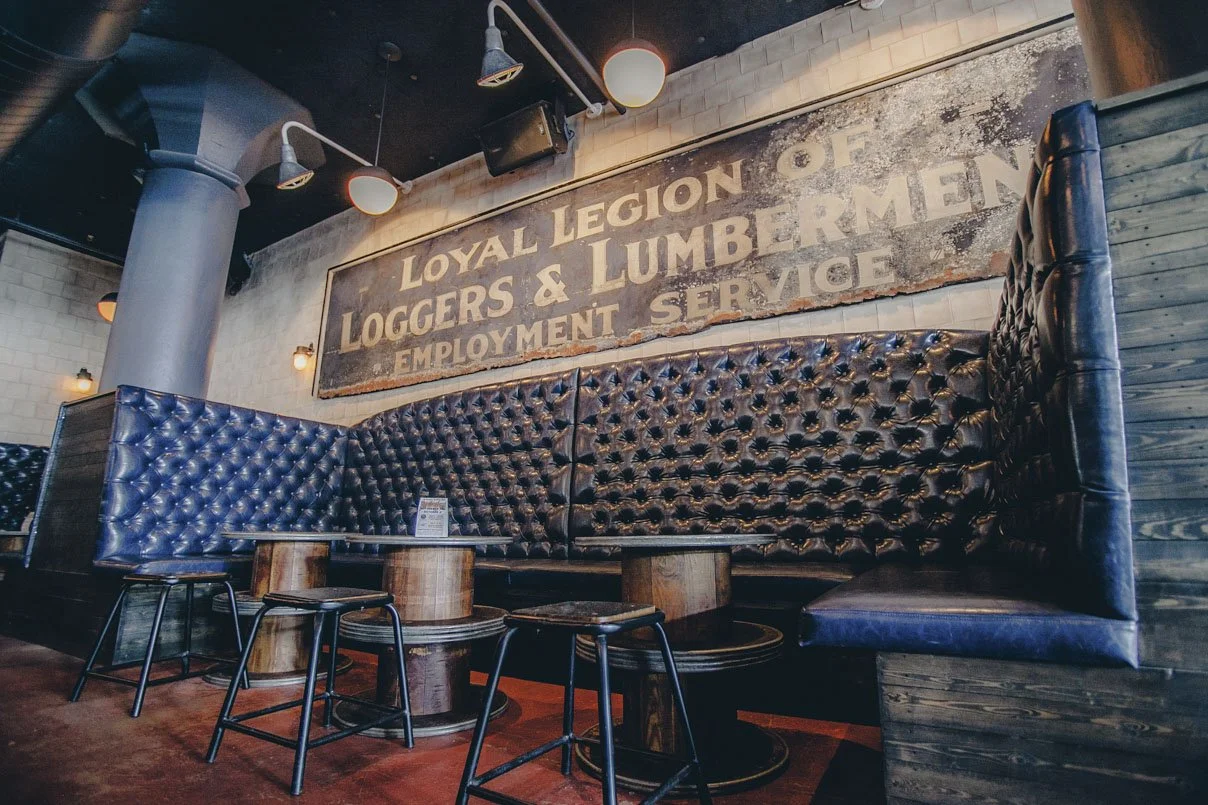
The true history of the 4Ls organization is more complex than we understood when we opened in August of 2015. Because of our building's historic nature, our progressive wage structure, and the origin of our sign, we've received significant interest from both architectural and labor historians. One of them, Norm Diamond, reached out to share the full story:
"The Loyal Legion of Loggers and Lumbermen (4Ls) was a unique Northwest organization, founded in 1917 during a strike wave to restore spruce lumber production needed for building US Army Air Force airplanes. During the summer and fall of 1917, loggers and millworkers went on strike demanding an eight-hour workday, regular paydays, access to showers and latrines, furnished bedding in camps, and fair hiring practices free from exploitative agencies. The Army intervened — breaking the strike through a combination of intimidation and reforms, then enlisting both employers and workers into the 4Ls. Its first leadership consisted of one hundred assigned military officers, and among its approximately one hundred thousand members were about twenty-five thousand soldiers of the Army Spruce Production Division."
— Norm Diamond, Ph.D, Former President, Pacific Northwest Labor College